AI for Wedding & Event Venue Inquiries: The 2026 Operator Guide


Your CRM is already tracking the client, and the floor plan, the BEO, and the deposit are all safely locked in your ops software. That is good, but…
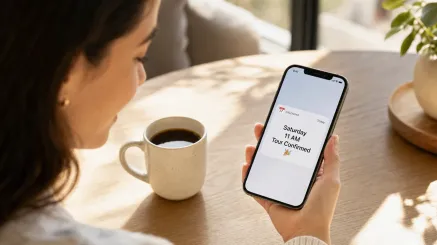
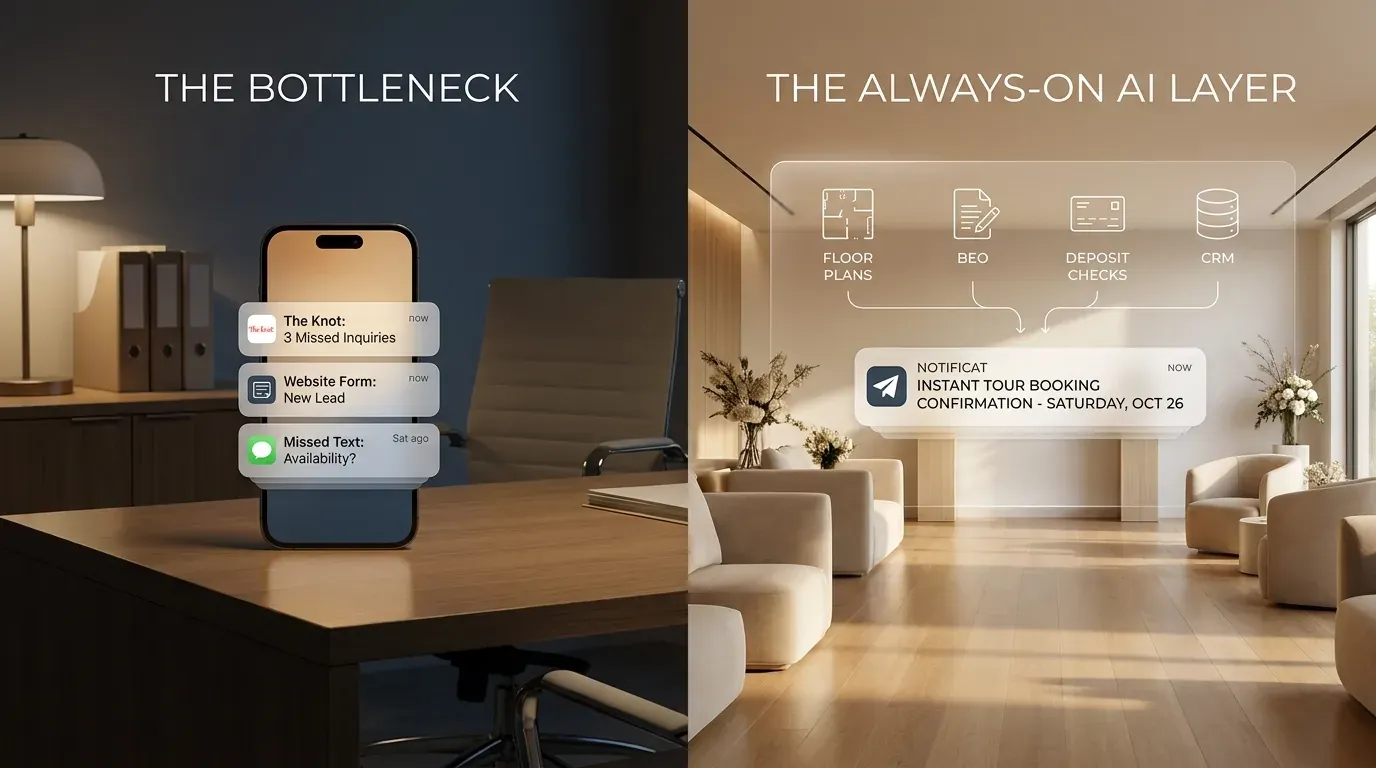
Did you know that a lot is determined within the very first hour after an inquiry, which is even more significant if that inquiry comes on a Saturday night from The Knot, a website form, a text, or a missed call. Without an immediate reply, that couple is already comparing three other venues. If they don’t get a meaningful reply and can’t review available tour slots while they’re still fully focused on searching for the right wedding venue, they’ll simply turn to other providers that can offer that.
This is what AI for wedding venues aims to solve in 2026. Not a generic chatbot in a contact form. Not a replacement for Tripleseat, HoneyBook, or Perfect Venue. Not a substitute for the CRM you already love.
What you need now is an always-on inquiry layer. You need a solution that can capture the lead, reply instantly and efficiently, qualify the prospect, book the tour, and hand a polished conversation to the person who will close the deal.
Key takeaways
- After-hours coverage is an operations problem. You won’t solve it by just hiring more staff.
- The 2026 job is now officially a loop: capture → reply → qualify → book a calendar slot → transfer to a human.
- Keep the CRM and ops stack. AI is responsible for speed-to-first-response and tour booking.
- Track KPIs: median response time, inquiry-to-tour conversion, walkthrough show rate, and post-tour closing percentage.
- Leads are often lost because of sending price-dump responses, failing to offer a calendar link, creating weekend response black holes, and dismissing marketplace leads as “low quality.”
- AI gets a tour on the calendar. Humans close the deal.
What are the risks of having only humans to cover after-hours inquiries?
Let’s start from the obvious: wedding venue inquiries do not arrive in a neat 9-to-5 queue. That’d simply be too good to be true.
Venue inquiries come from various sources, be it The Knot, WeddingWire, the website form, email, SMS, and voicemail – all this can happen at once, at inconvenient hours, without any warning in advance.
If you employ only humans to handle all the inquiries, you’re likely facing the following:
First reply is late. As Breezit's live blog noted, WeddingPro claims that up to 50% of bookings go to the vendor that replies first. A couple who sent the same dates to four venues booked the tour with the one that answered tonight.
Qualification is uneven. One coordinator asks only about guest count and date flexibility. Another sends a rate card and hopes for the best. The third one concentrates too much on whether the couple wants to celebrate indoors or outdoors. Conclusion: the same lead might look “hot” or “dead” depending on who was on duty that night.
The calendar isn’t offered. The couple asked if the venue was available on April 18. They did not ask for a template response, not to mention a response with a standard brochure. If the reply cannot hold a tour or a call on a live calendar, the conversation is very likely to die eventually.
You face a capacity deficit rather than a coordination issue. You cannot cover all weekend channels and still host the Saturday 2:00 p.m. tour. Invoca's research in 2025 shows that 67% of high-stakes buyers prefer to call in, yet only 61% of those callers manage to reach a human.
None of this means your team is slow or careless. It simply means the inquiry system was designed for office hours. The demand, however, is not.
The 2026 inquiry loop: capture → reply → qualify → book a calendar slot → transfer to a human
Good AI for wedding venues should be able to do five jobs.
1. Capture. Marketplace, website form, email, SMS, and phone must land where the system can see them. A Knot notification in one inbox and a form in another won’t do the trick.
2. Reply first. Answer the question asked, sound like your venue, and give a next step. Forget about old-school “Thank you, we’ll be in touch.”
3. Qualify. Collect enough information to decide if a tour is worth the hour: event type, date or range, guest count, indoor or outdoor, ceremony + reception vs reception only, budget. The first email should not turn into a lengthy college-like application.
4. Book a calendar slot. Offer real tour or call slots. Confirm. Remind. If they go quiet, follow up with context; do not use anything like “just checking in.”
5. Transfer to a human. When the lead is qualified, or asks something the system should not invent, a human steps in. The CRM should already have the conversation stored and the tour booked.
AI venue inquiry response does not close the deal but gets you a tour that has already been booked.
Keep the CRM. Add an AI inquiry layer.
HoneyBook, Tripleseat, Perfect Venue, and the CRM you already run are built for pipeline, contracts, BEOs, floor plans, and deposits. And they all are good and useful, so keep them. Yet, they are not built to screen all venue inquiries for first response and tour booking at every second, on every channel.
When talking about AI for wedding venues, you must think in jobs:
| Job | Human-only coverage | AI inquiry layer | CRM / ops stack |
|---|---|---|---|
| First reply on nights and weekends | Depends on who is awake | Is responsible for the first useful response | Stores the contact |
| Qualify event details | Inconsistent, depends on the person | Collects the same data every time | Holds the record |
| Offer and book a tour | Calendar ping-pong | Books based on live availability | Shows the appointment |
| Pipeline, BEO, contract admin | Manual after the tour | Optional later in the same sales path | Record in the system |
| Trust, walkthrough, close | The actual human job | Transfers to humans | Tracks the deal |
The conclusion is straightforward: keep HoneyBook, Tripleseat, and Perfect Venue, but add an AI inquiry layer that is responsible for efficient first-response and tour booking and can write the conversation back into those tools.
Breezit’s CRM philosophy is the same:
- Maintain your current system with connected inboxes and calendars.
- Add seamless integrations: direct connection to Tripleseat, plus Zapier integration for HoneyBook, GoHighLevel, Zoho, and Releventful.
- Your existing operations and team habits stay exactly as they are.
- AI venue inquiry layer automatically captures leads during the hours your team is offline.
Channels that are important in venue inquiries
Relax – you don’t need to have all the possible channels ready to get started with AI for wedding venues. The following are more than enough.
Marketplace. The Knot, WeddingWire, Zola, and similar portals send paid leads that go cold in hours. It’s important to understand that a couple who inquired at three venues at 9 p.m. is a shared lead. It’s not a bad lead, but it’s also not only your lead.
Take Stone Crest Venue as a good example of a marketplace-heavy business model. According to owner Ryan Cottam on the Breezit homepage, the venue relies a lot on platforms like The Knot and WeddingWire. By deploying AI for wedding venues to automatically capture and convert that initial surge of early inquiries, they have secured more than 200 booked tours!
Website form. Usually your highest-intent digital channel. If inquiries sit there unread until Monday morning, it becomes just a suggestion box.
Email. Pretty fine for packages. Even so, the next step is still a calendar offer. Another paragraph won’t do the job.
SMS / chat. Use it for first response and reminders.
Phone (optional). Voice is just a communication channel, it’s not the main product, so don’t build your entire system around phone calls only while ignoring your website form and marketplaces. Though missing a call might have a financial cost, you can solve this issue using AI Phone Receptionists.
Omnichannel communication only works if it feels like a single conversation. A couple who emails you on Saturday and texts you on Sunday should never have to explain their guest count or details twice. See how omnichannel communication impacts venue bookings.
Operator checklist: SLAs, qualification, calendar, takeover
Use this checklist to move from first response to human takeover.
First-response SLA
- Define what the first meaningful reply is.
- Set target windows for nights, weekends, and holidays.
- For example, Breezit operates on an always-on system: it captures and replies to every inquiry in under five minutes, day or night. You may use this automated standard as a reference point to measure your own team’s median response times.
Qualification fields (ask once, store forever)
The minimum set for most wedding and event venues should include:
- Event type (wedding, corporate, private, other)
- Preferred date or date range (plus flexibility)
- Guest count or range
- Ceremony + reception vs reception only
- Indoor vs outdoor event
- How they found you (marketplace, website, referral, other)
- Budget range (optional)
Don’t ask for a full vision board before you offer a tour.
Calendar rules
- Specify which calendars affect real-time availability (Owner, Sales, or Venue Walkthrough slots).
- Define standard tour lengths, transition buffers, blackout dates, and same-day booking cutoffs.
- Clearly say the terms (for example, is a slot a soft “space hold,” a confirmed “tour slot,” or a “needs manual review” request?).
- Create the exact confirmation and reminder workflow across various channels.
- In case of a no-show, establish an immediate, proactive reschedule offer instead of letting the lead go cold.
Human takeover
Decide when a person must step in:
- Custom pricing or a package you have not approved
- A question the knowledge base cannot answer
- High-stakes conversation
- A qualified tour that is 24 hours out
- Any request to change a signed hold or contract
According to Breezit's published FAQ, human operators can override at all times. Users can pause or turn off the AI sales assistant completely, review conversations in real time, disable the tool for a specific lead and manually take over the chat. You should demand this exact level of control bar from any inquiry layer you choose to implement.
Metrics not to overlook
You don’t need vanity stats such as how many chats were opened or how many AI messages were sent. Track the following five numbers.
1. Median first-reply time. Forget about the average, track the median response time. Clearing a pile of old weekend messages on Monday morning might show a very good average response time. It makes your team look fast on paper but hides the fact that weekend leads waited 48 hours for a reply.
2. Lead response rate. How many leads respond.
3. Inquiry → tour rate. Measure how many captured, raw inquiries successfully convert into a booked venue walkthrough or sales call. This is the main job the AI venue inquiry layer is supposed to do.
4. Tour show rate. Calculate the percentage of booked couples who show up to their appointment.
5. Post-tour close. Evaluate final sales conversions. If tours go up but close rates go down, your layer is pushing unqualified walkthroughs to your sales team.
Looking for some evidence of the significant impact that AI for wedding venues can have? Take a look at these Breezit-published customer results:
- Binksberry Hollow (Kristen Leen, also on the live sales-reps post): The venue already had high demand, but slow response times were a bottleneck. AI helped them to achieve a +25% increase in inquiry-to-tour conversion by implementing faster replies, early Q&A, qualification, and automated calendar bookings.
- The Beautiful Event Center (Regina & Will): The center reduced initial response times from 1-2 business days to 5 minutes and cut proposal creation to 2 minutes. As a result, they generated $10,000 in bookings within the first 10 days!
- Good Life Resorts (Rylie Jennings): The facility had an amazing +50% increase in lead-to-tour conversion.
What actually kills tours
Weekend black holes. Did you know that marketplace and website leads are most active on Saturday evening through Monday 9 a.m.? You do want that window covered.
“Marketplace leads are low quality.” Yes, some are, but many are just shared leads, and your competitors might simply be faster to reply. If three venues got the same Knot inquiry and you replied only on Tuesday, don’t blame the leads, blame your response rate.
AI with no knowledge base. If AI for wedding venues cannot explain your capacity, rules, and what you will not host, it may start inventing things. Teach your AI to use only approved answers.
Replacing the CRM with “go all-in on AI.” Fragmented workflows lead to lost BEOs and missed deposits. AI should simply accelerate bookings but not become your entire event ops platform.
Why Breezit
Breezit (justbreezit.com) is an AI sales assistant for venues. The software functions as an inquiry layer across your website forms, emails, SMS text messages, phone calls, and marketplace platforms. It instantly captures and nurtures every lead and lets you maximize your existing inbound pipeline.
In a nutshell, Breezit’s AI for wedding venues provides:
- Omnichannel coverage across email, SMS, phone, and portals such as The Knot, WeddingWire, and Zola
- Instant personalized replies and 24/7 Q&A based on your venue knowledge
- Smart follow-ups so threads do not go cold
- Real-time availability checks and tour booking on your calendar
- CRM sync so the tools you already use remain the undisputed system of record
The system can also handle advanced features like preliminary proposals, contracts, e-signatures, and Stripe payments, but these should be introduced later. The first week of your implementation should focus entirely on your first-response times and booking tours. This initial phase is not a close-path project.
Commercial & platform facts about Breezit:
- Plans begin at $99 per month.
- Tier-based plans scale with your inbound inquiry volume.
- Fully flexible terms – cancel anytime.
- A typical setup takes just 30 to 45 minutes.
- Backed by a 30-day money-back guarantee if you actively utilize the platform for at least 7 days (managed directly via support@breezit.com).
- Trusted by 400+ active event venues.
- An elite 4.9 out of 5-star rating on Trustpilot.
- Delivers an average of +50% more booked appointments.
- Saves venue operators approximately 20 hours of manual work per week.
- An under-5-minute response window
- 100% of incoming inquiries are successfully captured and replied to
The 21-Day Inquiry Layer Implementation Roadmap
7 days – coverage
- Connect your core inbound channels – a minimum setup of your marketplace links, website form, and main email inbox.
- Create your venue’s custom knowledge base and launch your live calendar scheduling.
- Measure your true median first-reply times (separate weekday speed from weekend performance).
- Actively monitor the system and review conversations.
14 days — tours
- Compare your current inquiry-to-tour conversion numbers against your pre-AI data.
- Implement an automated text and email reminder sequence (this will help you improve your tour show rates).
- Define the rules when humans must step in.
21 days — the close stays human
- Verify that your post-tour close rate remains stable or increases (if it drops, review your automated qualification criteria).
- Make sure that your existing CRM remains your absolute, undisturbed system of record.
- Completely get rid of the tedious Monday morning exercise of auditing unanswered weekend messages.
- Evaluate your results and decide if you want to keep proposals and contracts manual or migrate them into the same automated system.
Having doubts whether this inquiry layer fits your sales model? Schedule a 15-minute 1:1 Venue Fit Check on the Breezit homepage. You can run this evaluation completely risk-free – no need to rip out Tripleseat, HoneyBook, or Perfect Venue to test the system.
FAQ
Does AI for wedding venues replace my coordinator?
No. AI covers hours and first-touch work that a coordinator simply cannot do on every single channel. The coordinator, however, still runs the tour and closes the deal. See how AI helps sales reps close more bookings.
We already have HoneyBook / Tripleseat / Perfect Venue. Why should we add anything else?
Those platforms are built to manage deals and events, but they don’t capture midnight leads and book a tour onto your calendar before Monday morning. Keep your current CRM as your system of record; add an inquiry layer for instant first-response times and booking speed.
Will AI sound like a bot and scare couples off?
AI might sound like a bot if you feed it a generic script and never review its conversations. If you train it using your actual venue policies and set it up so it transfers complex questions to a human, it will become a true member of your team. For more details on personalization, refer to this article: Why AI Personalizes Responses Better Than People.
What about marketplace leads that never convert?
Before you cut your advertising budget, fix your response speed and your calendar offer. Marketplace leads from platforms like The Knot and WeddingWire might be high-value inquiries – don’t underestimate them. All you need to make them “hot” is a same-night reply, upfront qualification, and an immediate invitation to book a tour.
Can I turn it off or take over a lead?
Yes. You can pause it and take over one lead anytime.
How long does setup take, and what does it cost?
A typical setup is 30–45 minutes, which covers channels, calendars, and basic business information. Pricing starts at $99/month with tier-based plans (flexible terms allow you to cancel anytime).